

Osseointegration Implants Market to reach USD 20.78 Billion by 2035 at 8.72% CAGR
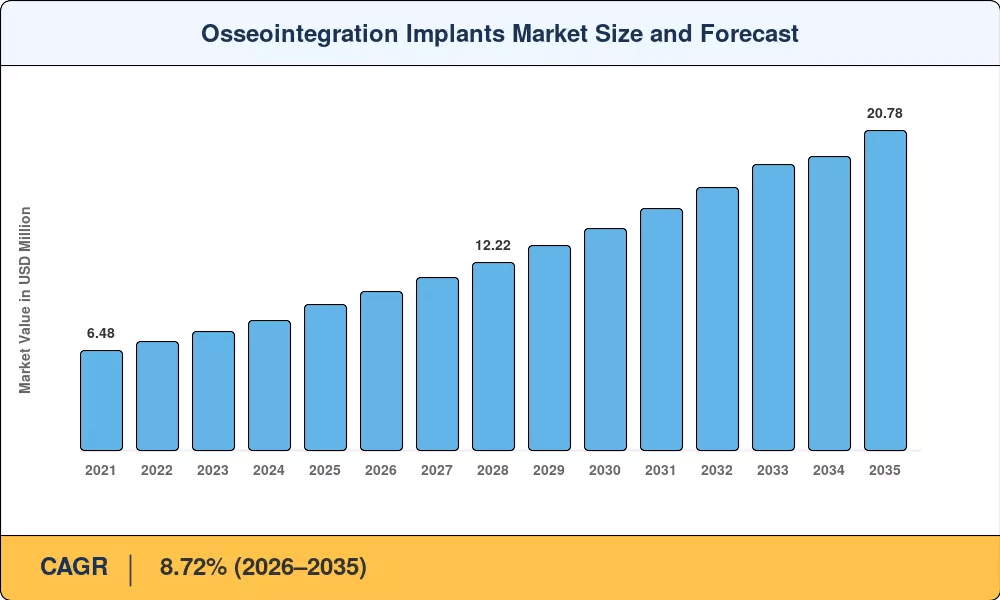
Osseointegration Implants Market Size
Osseointegration Implants Market to Surge from USD 10.34 Billion in 2026 to USD 20.78 Billion by 2035---Powered by Aging Demographics, Reimbursement Expansion
NY, CA, UNITED STATES, June 16, 2026 /EINPresswire.com/ -- As per Market Research Future, the global Osseointegration Implants Market size to reach USD 20.78 Billion by 2035 from USD 10.34 Billion in 2026, at a CAGR of 8.72% during the forecast period 2026--2035. The market base was estimated at USD 9.51 Billion in 2025.The 8.72% CAGR---anchored by structural demand from aging populations and expanding reimbursement frameworks---is driven by three converging forces: government-led coverage expansion for bone-anchored prostheses that continues to widen the addressable base, sustained innovation in titanium bone integration surface engineering that has shortened healing windows from 12 weeks to as few as 3--4 weeks, and the technological shift from conventional cemented fixation toward nano-textured coatings, laser-ablated micro-topographies, and bio-active/graphene-enhanced surfaces that improve implant survival and expand treatable populations.
National governments and multilateral health organizations are amplifying this momentum. The U.S. Centers for Medicare & Medicaid Services broadened coverage for osseointegrated limb prostheses in 2024, while the EU's Medical Device Regulation (MDR 2017/745) continues to accelerate CE-mark approvals for next-generation biocompatible implant materials. In 2024, Japan's Ministry of Health reported a 12% year-over-year growth in implant-supported overdenture treatments, demonstrating how the market for osseointegration implants is sustained by population aging.
With over USD 4.2 billion in venture and corporate R&D investment flowing toward sensor-enabled smart implants during 2023--2024, the global orthopedic bone fixation device pipeline is attracting capital at unprecedented levels. Together, these initiatives are creating the reimbursement infrastructure and delivery innovation on which the Osseointegration Implants Market depends.
Request A Free Sample:
https://www.marketresearchfuture.com/sample_request/6740
Key Market Trends & Growth Drivers
Aging Demographics and Rising Edentulism
According to recent sources, there will be more than 2.1 billion people over 60 worldwide by 2050, up from 1.4 billion in 2023. The sheer size of the aging population directly increases the addressable pool for dental implant surgery, even if edentulism---complete tooth loss---has decreased to about 15% among individuals over 65 in high-income countries because of improvements in preventative dentistry. In 2024, Japan's Ministry of Health reported a 12% year-over-year growth in implant-supported overdenture treatments, demonstrating how the market for osseointegration implants is sustained by population aging. Each percentage point of edentulism prevalence translates into measurable procurement volume, and the implant osseointegration process embedded in routine geriatric care makes this driver structurally durable through 2035.
Reimbursement Expansion for Bone-Anchored Prostheses
Expanded coverage requirements for percutaneous osseointegrated limb prosthesis were finalized by CMS in 2024, greatly lowering qualifying amputees' out-of-pocket expenses. More than 100 bone-anchored amputee surgeries are currently carried out annually with full public insurance coverage at Sweden's Sahlgrenska University Hospital, the cradle of modern osseointegration. These changes in policy increase patient access to orthopedic bone fixation options and eliminate major financial obstacles. China's National Healthcare Security Administration expanded DRG-based reimbursement for dental implants across 36 pilot cities in 2024, while India's Ayushman Bharat scheme now covers over 550 million citizens and is progressively adding implant-based orthopedic bone fixation procedures to its benefits package. Together, these initiatives are creating the procurement infrastructure and delivery innovation on which the Osseointegration Implants Market depends.
Advances in Surface Engineering and Biocompatible Implant Materials
Next-generation implant surfaces --- including SLActive (Straumann), TiUltra (Nobel Biocare), and laser-lock micro-channel designs --- reduce healing times from 12 weeks to as few as 3--4 weeks by accelerating the implant osseointegration process. A 2024 meta-analysis published in the Journal of Clinical Periodontology found that hydrophilic nano-textured surfaces improved 5-year implant survival rates to 97.8%, compared with 94.1% for machined surfaces. Investment in biocompatible implant materials R&D exceeded USD 1.1 billion across major manufacturers in 2024. Recombinant surface engineering platforms have largely displaced conventional machined surfaces, improving safety and yield.
In areas where coverage is limited by compromised bone quality and healing logistics, investment in delivery technologies is accelerating uptake. The overall program economics are improved by decreased revision burden and shorter time-to-loading. Sensor-enabled smart implants and graphene-enhanced coatings will reframe cost structures---as per-device costs fall with scale, the addressable channel widens from tertiary centers to community clinics and ambulatory surgical centers, extending titanium bone integration beyond traditional settings.
Ask for Customization:
https://www.marketresearchfuture.com/ask_for_customize/6740
Market Segment Insights
BY PRODUCT TYPE
Dental Implants: Dominant segment with ~56.2% revenue share in 2024. Reflecting decades of installed clinical capacity and the necessity of fixed prosthetic solutions over removable dentures. Approximately 180 million Americans are missing at least one tooth, while Europe's edentulous population exceeds 70 million. Straumann's BLX and BLT systems and Nobel Biocare's NobelActive anchor this segment.
Bone-Anchored Limb Prostheses: Fastest-growing technology class at 12.2% CAGR (2026--2035). Percutaneous osseointegrated systems that deliver documented improvements in hip range of motion, sitting comfort, and osseoperception compared to socket-based prostheses. As military and civilian rehabilitation programs consolidate around bone-anchored products, manufacturers able to supply FDA-cleared OPRA systems capture a disproportionate share.
Spinal & Other Orthopedic Implants: Contributed USD 2.14 billion in 2024 revenue, underpinned by rising spinal fusion procedure rates in patients over 60. Degenerative disc disease prevalence and aging demographics sustain this segment.
Other Formulations: Ceramic alternatives and polymeric/composite platforms largely emerging from niche applications; legacy demand in select markets.
BY MATERIAL TYPE
Metallic (Titanium Alloy): Dominant application with ~71.8% of market demand in 2024. Driven by decades of documented clinical performance in orthopedic bone fixation, with commercially pure titanium (CpTi) and Ti-6Al-4V alloy commanding unmatched osseoconductive properties and 98%+ ten-year survival rates.
Ceramic (Zirconia): Fastest-growing material segment at 13.6% CAGR. The aesthetics-conscious dental patient seeking metal-free biocompatible implant materials creates a structural premium segment that pooled-procurement regions cannot match. Yttria-stabilized zirconia appeals particularly in the anterior dental zone.
Polymeric & Composite: Niche segment; primarily PEEK-based spinal fusion cages and craniomaxillofacial applications requiring radiolucency.
Bio-active/Graphene-enhanced Coatings: Emerging segment at 14.9% CAGR; pipeline candidates include graphene oxide layers demonstrating 40--60% increases in osteoblast adhesion in pre-clinical studies, potentially revolutionizing the implant osseointegration process for osteoporotic patients.
BY END USER
Hospitals & Ambulatory Surgical Centers: Largest segment at ~47.9% share in 2024. National procurement through ministries of health and complex multi-unit cases dominate volume, channeling routine implant supply for full-arch reconstructions, zygomatic implants, and all bone-anchored limb prosthesis procedures.
Dental Clinics: USD 3.28 Billion in 2024, serving as the physical point of single-tooth and partial-arch replacements in outpatient settings.
Orthopedic & Rehabilitation Centers: Fastest-growing channel at 10.7% CAGR. Dedicated orthopedic bone fixation facilities expanding osseointegration programs for amputees.
Other Settings: Emerging segment; medical tourism destinations and travel clinics represent incremental demand channels.
Read Detailed Insights:
https://www.marketresearchfuture.com/reports/osseointegration-implants-market-6740
Regional Outlook
North America --- Dominant Market (~37.1% Share, 2024)
The United States generates approximately 78.4% of North American Osseointegration Implants Market revenue, driven by over 5 million dental implant procedures performed annually and a growing pipeline of bone-anchored limb prosthesis cases channeled through the VA healthcare system---a single policy shift that converted a denture-dominated market into one with a structural orthopedic tail. Reimbursement breadth and adult catch-up programs support premium-priced titanium bone integration demand that price-compressed regions cannot match.
Canada contributes through provincial health plan inclusion of implant protocols, while Mexico is growing on dental tourism from the U.S. and Canada. North America's leadership rests on reimbursement depth and the structural adult segment created by expanded CMS coverage and military rehabilitation mandates.
Europe --- Second Largest (USD 2.70 Billion, 2024)
Europe's Osseointegration Implants Market reflects divergent national strategies---Germany's statutory health insurance (SHI) system reimburses implant-supported overdentures at rates covering 50--65% of procedure costs, while the UK historically used selective targeting before broadening coverage. Germany leads regionally with strong SHI reimbursement for implant-supported prosthetics and a 2024 contribution reflecting 24.6% of regional share.
The UK contributes on NHS pilot programs for osseointegrated limb prostheses transitioning toward broader coverage. France contributes USD 0.38 Billion through ANSM-regulated fast-track approvals for ceramic implants. Italy contributes on long-standing high private-practice dental implant volumes. Harmonization pressure from ECDC guidance is gradually narrowing these differences, lifting baseline demand across the region. The Nordic countries are growing at a steady pace on early adoption of smart biocompatible implant materials. Spain contributes on dental tourism growth from Northern Europe. Russia holds ~5% of regional share through government hospital procurement programs.
Asia-Pacific --- Fastest-Growing Region (11.5% CAGR, 2026--2035)
Asia-Pacific is the engine of the Osseointegration Implants Market. China holds the largest regional share with a national volume-based procurement program that reduced average dental implant prices by 55% in 2024, dramatically widening patient access, growing at a solid CAGR. India is growing at 13.2% CAGR on the back of Ayushman Bharat coverage expansion and Apollo Hospitals and Manipal Group investing in dedicated implantology centers across tier-2 cities.
ASEAN economies show the steepest growth as dental tourism hubs in Thailand and Vietnam mature. Japan contributes USD 0.41 Billion through super-aging population driving overdenture demand at 4.8% CAGR. South Korea is growing at 10.4% CAGR on National Health Insurance implant coverage for citizens aged 65+. The rest of Asia-Pacific is growing at 9.7% CAGR on hospital infrastructure build-out. The region's combined contribution anchors the global volume base for implant demand.
Middle East & Africa --- Emerging Opportunity (9.2% CAGR, 2026--2035)
The Middle East & Africa carries the widest coverage gap and therefore the steepest opportunity. Saudi Arabia's Vision 2030 healthcare cluster investments lead the region with mandatory infant and adult programs, contributing the largest regional share in 2024. The UAE contributes on medical tourism positioning and JCI-accredited facilities at 10.8% CAGR. South Africa is growing at a solid pace on private hospital chains expanding implant services, contributing USD 0.07 Billion.
Egypt contributes on government trauma center modernization at 9.5% CAGR. Government hospital modernization underpins sub-Saharan demand across the rest of the region. The Africa CDC goal of producing 60% of the continent's vaccines locally by 2040 will reshape supply geography and tender dynamics. Cold-chain and specialized surgeon training gaps remain a restraint---fewer than 8,000 surgeons globally possess the necessary skills for intricate percutaneous bone-anchored limb prosthesis procedures, limiting volumes in challenging regions.
South America --- Growing Presence (USD 0.57 Billion, 2024)
Brazil anchors South America's Osseointegration Implants Market at ~62.5% of regional revenue, with over 27,000 registered dental practices offering implant services providing a stable demand floor that smooths regional forecasts through the national immunization program. Argentina contributes through growing middle-class demand for fixed prosthetics at 7.9% CAGR.
The rest of South America is growing steadily on gradual insurance penetration for implant procedures. South America's procurement runs largely through private dental chains, which pool demand to secure competitive pricing. The region's stable demand base supports manufacturer volume planning even as per-unit tender prices compress margins.
Competitive Landscape and Recent Developments
The Osseointegration Implants Market is moderately concentrated, with an estimated Herfindahl-Hirschman Index in the 900--1,200 range and the top five suppliers holding roughly 42--48% of global revenue. Concentration is highest in high-income segments where regulatory and manufacturing barriers are steep; the pooled-procurement tier is more fragmented as regional producers compete on price.
The competitive landscape is stratified between premium titanium bone integration leaders serving adult and private markets, high-volume low-cost suppliers capturing Asia-Pacific tenders, and ceramic/combination specialists consolidating the aesthetic segment.
KEY COMPANIES AND RECENT MILESTONES
Straumann Group (2024--2025): Maintains leadership with BLX, BLT dental implant systems and the Roxolid material platform, commanding ~12--15% of global Osseointegration Implants Market revenue. Premium innovation leader in titanium bone integration offsets tender-price compression in pooled procurement.
Envista Holdings (Nobel Biocare) (2024--2025): NobelActive, TiUltra surface technology, and All-on-4 anchor a strong global franchise, holding ~9--12% of global revenue. The company benefits from the broadest product portfolio across surgical protocols and digitally traceable implant platforms.
Zimmer Biomet (2024--2025): Trabecular Metal, T3 implant, and spinal fusion devices anchor cross-platform dental and orthopedic bone fixation, holding ~7--10% of global revenue. The company leverages common Ti-6Al-4V alloy processing lines for both dental and spinal implant production.
Dentsply Sirona (2024--2025): Astra Tech OsseoSpeed, Ankylos, and integrated CAD/CAM workflow command ~6--8% of global revenue. The integrated digital planning ecosystem reinforces the guided-surgery case with proven titanium bone integration outcomes.
Future Outlook: 2026--2035
By 2030, digital surgical planning and AI-enabled workflows will become the operating system of implant delivery. Deep-learning algorithms can now predict optimal implant positioning from CBCT scans with sub-millimeter accuracy, reducing placement errors by up to 38%. Robotic-assisted dental implant surgery platforms from companies like Yomi (Neocis) and CMR Surgical are entering clinical use, promising consistent outcomes across varying surgeon experience levels. By 2030, AI-guided workflows could account for 25% of all implant placement procedures in high-income markets, enabling precision tracking that lifts survival rates---the metric most correlated with Osseointegration Implants Market growth.
Sensor-enabled smart implants and 3D-printed patient-specific scaffolds will reframe cost structures by the early 2030s. As per-device costs fall with scale, the addressable channel widens from tertiary centers to community clinics and ambulatory surgical centers, extending titanium bone integration beyond traditional settings. Self-monitoring via embedded sensors and remote monitoring subscriptions open non-clinical revenue streams that could materially widen the addressable base. An estimated 15% of future implant platforms could have embedded electronics by 2030, creating opportunities for data monetization through subscription-based remote monitoring services.
More Related Research Insights:
https://www.marketresearchfuture.com/reports/dental-implants-market-2753
https://www.marketresearchfuture.com/reports/orthopedic-implant-market-838
https://www.marketresearchfuture.com/reports/craniomaxillofacial-devices-market-8011
https://www.marketresearchfuture.com/reports/bone-graft-substitutes-market-1195
https://www.marketresearchfuture.com/reports/prosthetics-orthotic-market-43404
https://www.marketresearchfuture.com/reports/joint-replacement-market-43209
https://www.marketresearchfuture.com/reports/spinal-implants-market-2050
https://www.marketresearchfuture.com/reports/biomaterial-market-2021
https://www.marketresearchfuture.com/reports/regenerative-medicine-market-2220
https://www.marketresearchfuture.com/reports/trauma-fixation-devices-market-11709
Larry Wilson
WantStats Research And Media Pvt. Ltd.
+1 855-661-4441
email us here
Visit us on social media:
LinkedIn
Facebook
YouTube
X
Legal Disclaimer:
EIN Presswire provides this news content "as is" without warranty of any kind. We do not accept any responsibility or liability for the accuracy, content, images, videos, licenses, completeness, legality, or reliability of the information contained in this article. If you have any complaints or copyright issues related to this article, kindly contact the author above.
